Thank you! ^^
Here's a temporary link that expires in about 7 days:
https://gofile.io/d/As0Szu
I have included the final release files in FLAC format and another ZIP which contains all of the organized and decoded chunks from the PAL version alongside M3U playlist files that memorize the orders I unscrambled.
I also checked the NTSC version, including the prototype, and I found no differences as the music chunks have all the same checksums even though many have different namings, but still with the same problem.
The answer to the sorting/unscrambling is complicated.
The short answer is:
Lots of different techniques combined together alongside lots of manual work, very attentive listening and analysis from different angles.
The long answer is:
I couldn't find any method/algorithm that could be automated by a script or a piece of code and that is because the 'scrambled' chunks don't have names of their own. That piece of information is missing.
Each time the script finds a chunk that has no name, it incrementally adds an ASCII underscore character to whatever the name of the previous chunk was, which is not indicative of where the chunk is actually supposed to be positioned in the original order.
For those chunks the original ordering information is lost, so it needs to be reconstructed.
Here's what I used to achieve that result:
Program/software list: foobar2000 with lots of various different plugins (including vgmstream), Adobe Audition, HxD and PSPad for hex editing and analysis, RayAudio for extraction, ffmpeg for regular audio conversions, some custom basic command-line utilities I coded myself in collaboration with other people (mostly regarding the manipulation of Sony 4-bit ADPCM chunks for the PS1 and PS2), HashTab and various other MD5/SHA-1 checksum utilities and more...
The reconstruction of the order of those unused chunks (even some of the used ones had their numbering wrong or in the reverse descending order) was possible also thanks to lots of reference material that has been uploaded on the internet over the years. The composer Daniel Masson himself posted MP3s of the soundtrack here and there on the internet, but those don't contain everything.
Another source of reference material was the GameCube version of the soundtrack funnily enough, because that version has the most consistent ordering with well-behaved numbering, even though it contains way fewer sequences.
For some sequences, using the source material wasn't enough.
So in some cases very attentive and repeated listening was required.
Sometimes the unused sequences would mimic the behaviour of known ones, meaning they'd evolve in the same way over time, but, for example, without drums, without specific instruments or with something that isn't present in the used ones.
It was verifiable by lining everything up and rapidly switching between files while carefully looking at the shapes in the spectrogram window.
So a lot of comparisons were made and lots of guesswork.
A more complex and technical approach was to carefully look at the consistency and coherence of waveforms and spectrograms between chunks.
What made it even more time-consuming was the fact that ADPCM in many forms, not just the Sony PlayStation variant, is not a 'seamlessly constant' stream, but it comes in 'packets' of fixed length.
Sony's ADPCM for the PlayStation for example compresses 28 16-bit samples of PCM data (56 bytes) into 16 byte-long packets of ADPCM data (1 for relative waveform positioning, 1 for flags and 14 for ADPCM audio).
That means: if you have a PCM stream that has a number of samples which is not a multiple of 28, you will have silence added as padding to fill up the last ADPCM packet.
This results in every single chunk of the soundtrack being characterized by a 'click' or a 'pop' at the end, which makes this analysis even more time-consuming.
I didn't fully fix them, but I found a way to make them 'a tiny bit smaller'.
The technical detail behind this is that, if you happen to tinker around with the available PlayStation SDKs, Sony's PlayStation ADPCM for some reason tends to add padding zeroes at the beginning (16 '0x00' null bytes at the beginning of each channel) which is always silence that wasn't there before the PCM to ADPCM conversion.
That first part of the problem is at the beginning of the file.
The other problem is at the end.
In order to make a Sony's ADPCM player stop properly, there should be a situation where the second to last chunk has a flag of 0x01 and the last one has a flag of 0x07, but for some reason that doesn't always happen.
What should happen is this (XXs could be any byte values):
XX 01 XX XX XX XX XX XX XX XX XX XX XX XX XX XX XX XX
07 07 77 77 77 77 77 77 77 77 77 77 77 77 77 77 77 77
But instead what happens is this:
XX 01 XX XX XX XX XX XX XX XX XX XX XX XX XX XX XX XX
07 00 77 77 77 77 77 77 77 77 77 77 77 77 77 77 77 77
That means that the last chunk gets interpreted as decodeable ADPCM audio which it shouldn't.
The consecutive 0x01 and 0x07 flags are what makes the ADPCM player to stop, but if the player doesn't see that 0x07 it will continue until the end of the file where there is no more data.
In other words the last chunk with that 0x07 flag shouldn't be decoded as audio.
Fixing this minor technical detail made the gaps smaller and it's a tiny improvement that maybe is not worth going through the trouble.
I decided to do it anyway with a few scripts I wrote and here's the difference of before and after:
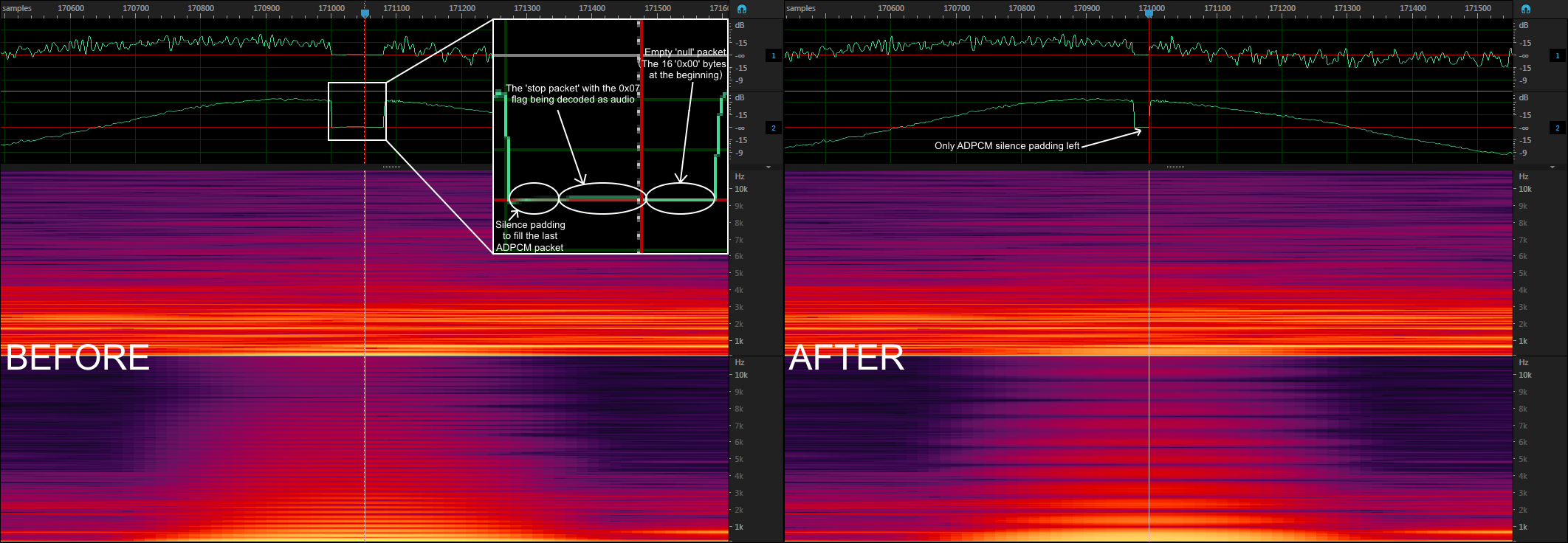
In the picture you can also spot that these two chunks are meant to be concatenated one after the other given the shape and the slope the waveform is following. Without that padding/trough in the middle they would connect consistently with one another.
Each chunk has a silence padding at the end of different length and there's no easy way to fix it once and for all for every single file without potentially obtaining unwanted results.
The details are even more complicated. It's doable-ish, but it would involve lots of extensive work.
Anyway, huge information dump, sorry ^^'
All of this isn't a perfect approach as it's time-consuming and prone to human error, but with enough time and maniacal/thorough checking, it can be done.
I think I'm happy with the end result, but it's possible that it may not fit for everyone.
Cheers! ^^

